
Article Outline
- Introduction: The Strategic Choice Between Nylon and Polyester
- The Material Selection Dilemma in Modern Manufacturing
- Key Decision Drivers for Industry Professionals
- Fundamental Properties: A Molecular-Level Comparison
- Chemical Structure and Its Impact on Performance
- Inherent Strengths and Weaknesses of Each Polymer
- Head-to-Head Performance Analysis
- Mechanical Properties: Strength, Abrasion, and Elasticity
- Environmental and Chemical Resistance
- Thermal Behavior and Dimensional Stability
- Application-Specific Recommendations
- Automotive and Transportation Industry (Tire Cord, Seat Belts, Airbags)
- Apparel and Performance Wear (Sportswear, Outdoor Gear, Fashion)
- Home Furnishings and Industrial Textiles (Carpets, Upholstery, Conveyor Belts)
- Specialized Uses (Ropes, Fishing Nets, Technical Fabrics)
- Customization and Specialization Options
- Denier and Filament Count Variations
- Cross-Section Modifications (Round, Trilobal, Hollow)
- Additive Integration and Special Finishes
- Blending and Composite Yarn Technologies
- Economic and Supply Chain Considerations
- Cost Analysis: Raw Material to Finished Product
- Production Efficiency and Processing Requirements
- Global Supply Landscape and Market Stability
- Sustainability and Future Trends
- Recyclability and Environmental Impact
- Bio-based Alternatives and Circular Economy
- Smart and Functional Fiber Innovations
- Procurement Strategy and Vendor Selection
- Key Specification Parameters for Custom Orders
- Quality Assurance and Testing Protocols
- Building Effective Supplier Partnerships
- Conclusion: Making the Informed Choice
- Decision Framework for Different Business Needs
- Long-term Value vs. Short-term Cost Perspective
- Frequently Asked Questions (FAQs)
1. Introduction: The Strategic Choice Between Nylon and Polyester
For procurement managers, product developers, and manufacturing executives across the textile value chain, Customized Nylon vs. Polyester Filament: An Industrial Buyer’s Guide the selection between nylon (polyamide) and polyester filament represents one of the most fundamental and impactful decisions in material sourcing. This choice extends far beyond a simple comparison of price per kilogram; it directly influences product performance, manufacturing efficiency, brand positioning, and ultimately, market success.
Customized synthetic filaments have become the backbone of modern industrial and consumer textile applications. The global market for high-performance and engineered filaments is projected to exceed $50 billion by 2026, with both nylon and polyester carving out significant and growing niches. As industries from automotive to athleisure demand ever-higher levels of functionality, the ability to specify and source the right filament for the specific application has become a critical competitive advantage.
This comprehensive guide provides a data-driven framework for evaluating customized nylon versus polyester filament. We will dissect their inherent properties, explore customization possibilities, and translate technical specifications into actionable business intelligence for professionals in apparel, textiles, carpeting, and industrial manufacturing.
2. Fundamental Properties: A Molecular-Level Comparison
The performance differences between nylon and polyester originate at the molecular level. Understanding these foundational characteristics is essential for predicting how each material will behave in the final application.
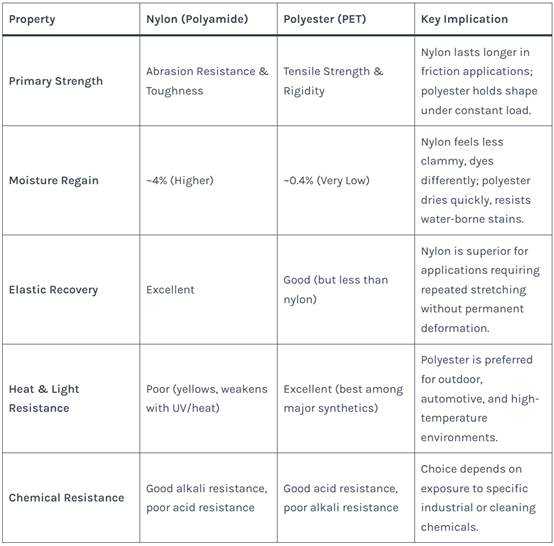
- Polyester (Polyethylene Terephthalate, PET): This fiber is formed from polymerized esters. Its molecular structure contributes to high strength, excellent resistance to stretching and shrinking, and low moisture absorption. Polyester is known for its “wash and wear” properties, maintaining shape well and offering good resistance to chemicals, except strong alkalis.
- Nylon (Polyamide): Characterized by amide linkages in its polymer chain, nylon’s structure grants it exceptional toughness, high elasticity, and superior abrasion resistance. It is less resistant to strong acids but handles alkalis better than polyester.
Table 1: Core Property Comparison at a Glance
3. Head-to-Head Performance Analysis
3.1. Mechanical Properties
For industrial applications, mechanical performance is non-negotiable.
- Strength: High-tenacity industrial polyester filaments are formidable, with standardized breaking strength often starting at ≥7.10 cN/dtex for high-modulus low-shrinkage (HMLS) types used in tire cord. Polyester’s strength is consistently high and less affected by moisture. Nylon, particularly nylon 66 used in industrial settings (as per standards like FZ/T 54013-2019), is renowned for its dynamic strength and exceptional fatigue resistance, making it invaluable in applications like tire cords that undergo constant flexing.
- Abrasion Resistance: Nylon is the undisputed champion. It is famously 10 times more abrasion-resistant than cotton and significantly outperforms polyester in applications involving constant friction, such as carpets, conveyor belts, and gears.
- Elasticity and Flexibility: Nylon fibers have a higher elastic recovery, meaning they can return to their original length after stretching better than polyester. This translates to better drape in fabrics and reduced bagging in carpets.
3.2. Environmental Resistance
- UV and Weathering: Polyester’s superior resistance to sunlight and weathering makes it the default choice for outdoor applications like awning fabrics, outdoor furniture, and geotextiles. Nylon requires heavy stabilization additives to perform in similar conditions.
- Moisture and Hydrolysis: Polyester’s low moisture absorption makes it stable in wet environments and resistant to mildew. Some specialty nylon grades are engineered for抗水解 (hydrolysis resistance), but it remains a general vulnerability for standard nylon in hot, humid conditions.
4. Application-Specific Recommendations
Selecting the optimal filament requires mapping its properties to the end-use’s most critical demands.
Table 2: Application-Driven Material Selection Guide

5. Customization and Specialization Options
The true power of modern synthetic filaments lies in customization.
- Denier and Profile: Beyond standard rounds, filaments can be engineered in trilobal shapes (for soil-hiding in carpets and increased surface area), hollow forms (for lightweight insulation), or other proprietary profiles that alter luster, hand-feel, and performance.
- Additive Integration: Masterbatch additives can be incorporated during polymerization or spinning to create:
- Antistatic filaments for electronics manufacturing.
- Flame-retardant (FR) grades for protective gear and home furnishings.
- UV-stabilized nylon for outdoor applications.
- Antimicrobial properties for healthcare and activewear.
- Blending and Co-engineering: For applications where one polymer’s weakness is critical, blending or bicomponent spinning (e.g., a polyester core with a nylon sheath) can create a filament that leverages the strengths of both. Polyesteramide fibers are an advanced example, combining ester chains and amide bonds to merge properties.
6. Economic and Supply Chain Considerations
- Cost Structure: Historically, nylon has been more expensive than polyester due to raw material costs (benzene derivatives vs. PTA/MEG) and more energy-intensive polymerization. This gap fluctuates with petrochemical market dynamics.
- Processability: Polyester generally has a wider and more forgiving processing window in texturing, heatsetting, and dyeing. Nylon requires more precise control, especially of temperature and moisture.
- Supply Security: Polyester supply chains are typically larger and more globally integrated, offering greater stability. Nylon, especially Nylon 66, has faced supply constraints due to precursor availability.
7. Sustainability and Future Trends
Sustainability is reshaping material choices.
- Recyclability: Mechanical recycling streams for post-consumer polyester (rPET) from bottles are well-established. Chemical recycling for both polymers is advancing. The industry is also developing bio-based versions (e.g., bio-PA from castor oil, bio-PET from plant sugars).
- Circular Design: There is growing demand for filaments designed for disassembly and recyclability at end-of-life, moving away from complex, inseparable blends.
- Smart Functionality: The future lies in filaments with embedded functionality—phase-change materials for thermal regulation, conductive fibers for wearable tech, and shapes that actively manage moisture or bacterial growth.
8. Procurement Strategy and Vendor Selection
When sourcing customized filament, move beyond basic specifications.
- Define Critical-to-Quality (CTQ) Parameters: Is it tensile strength, elongation at break, thermal shrinkage, or color fastness? Provide target values and acceptable tolerances.
- Request Technical Data Sheets (TDS) and Certifications: Ensure they comply with relevant industry standards (e.g., FZ/T, ISO, ASTM).
- Audit for R&D Capability: A supplier with a strong R&D department can co-develop solutions and troubleshoot application problems.
- Evaluate Consistency: Request statistical process control (SPC) data to verify batch-to-batch consistency, which is crucial for automated manufacturing.
9. Conclusion: Making the Informed Choice
There is no universal “best” filament—only the best for your specific application. Use this framework to guide your decision:
- Choose Nylon when your priorities are abrasion resistance, toughness, elastic recovery, and flexibility. Think durable carpets, high-performance athletic apparel, airbags, and any component subject to repeated stress or impact.
- Choose Polyester when your priorities are tensile strength, dimensional stability, UV/chemical resistance, and moisture management. Think tire belts, outdoor fabrics, high-strength industrial sewing threads, and products requiring excellent shape retention.
The most sophisticated approach may involve using both, each where it performs best, or investing in the development of a co-engineered or blended filament that delivers a unique property set. By deepening your understanding of these two polymer workhorses, you transform material selection from a cost center into a source of innovation and competitive edge.
10. Frequently Asked Questions (FAQs)
Q1: Is nylon always more expensive than polyester?
A1: Generally, yes, due to more complex raw materials and processing. However, the cost differential fluctuates with oil prices, and for specialized high-tenacity or modified polyesters, the price can approach or exceed that of standard nylon. Always compare based on total cost-in-use, not just price per kg.
Q2: Which is better for dyeing bright colors?
A2: Nylon typically accepts dyes more readily and can achieve deeper, richer colors at lower dyeing temperatures. Polyester requires higher-temperature dyeing with disperse dyes but offers excellent color fastness, especially to washing and light.
Q3: Can I get a filament that combines the best of both?
A3: Directly, no, as they are chemically distinct. However, you can achieve hybrid performance through:
- Physical Blending: Plying nylon and polyester yarns together.
- Fabric Blending: Weaving or knitting with yarns of each type.
- Advanced Polymers: Using engineered fibers like polyesteramide or through bicomponent spinning where one polymer forms the core and the other the sheath.
Q4: For outdoor furniture fabric, which is truly better?
A4: Polyester is overwhelmingly the preferred choice. Its exceptional resistance to UV degradation (maintaining ~60-70% strength after 1000 hours of exposure) and low moisture absorption prevent mildew, fading, and weakening. Nylon would degrade rapidly unless heavily and expensively stabilized.
Q5: How important is “dry hand feel” in activewear, and which fiber provides it?
A5: Very important for comfort. Polyester’s low moisture absorption means it can feel clammy with sweat as it doesn’t absorb it. Nylon has a higher moisture regain, which can contribute to a less clammy, more comfortable “dry” feel during intense activity, a factor noted in sportswear comfort studies.
Q6: What does “HMLS” stand for in polyester, and why is it critical?
A6: High Modulus, Low Shrinkage (HMLS). This is a premium industrial polyester grade. “High modulus” means high resistance to stretching under force (dimensional stability), and “low shrinkage” is vital for processes like tire curing. It is essential for tire belts, conveyor belts, and any application where stability under load and heat is critical.
Q7: Are there bio-based or recycled options for both?
A7: Yes. Recycled polyester (rPET) from plastic bottles is widely available and established. Recycled nylon (often from fishing nets or industrial waste) is growing. Bio-based options exist: Bio-PA (e.g., from castor beans) and Bio-PET (from plant sugars), though often at a premium and with varying performance profiles.
Q8: How do I test if a filament sample meets my needs?
A8: Beyond supplier TDS, conduct your own application-specific testing. For a carpet yarn, perform Martindale abrasion tests. For a sewing thread, test seam strength and abrasion. For automotive fabric, test tensile strength, tear resistance, and UV aging. Partner with a certified third-party lab for impartial results.